
Bookshelf: Jazz Break
Some thoughts about what I read over winter break

The longer I’ve been a professor, the more at peace I am with being a student. When I was working on my first book, I often toiled in silence out of fear that if I crowdsourced for citations I’d be written off as a dilettante even though I never judged my friends when they asked me for literature suggestions or a fresh pair of eyes. So now I try to approach knowledge gaps as opportunities to ask friends for reading recommendations. Because one thing I’ve learned while researching VH1 in the 90s for my next book project is how much I don’t know. For example, I spent much of my fall sabbatical watching episodes from the original run of Behind the Music and realized, even though I’ve read many music memoirs in my life, I still don’t really know much about rehab and how mental health services evolved alongside rock culture. And even though I went to grad school with several broadcast historians and got to take classes with Michele Hilmes before she retired, I still know very little about adult contemporary radio.
You know what else I don’t know much about? What was going on with jazz in the 1980s. I know some names and some labels, but I don’t have a lot of context. Why would I need to know this? Because I’m currently working on a chapter about New Visions, a music program that ran on VH1 from 1986-1990. It began as a showcase for new age music videos, then evolved into a progressive performance show first hosted by a bunch of musicians and later Ben Sidran, and finally expanded into a multi-genre revue emceed by Nile Rodgers before it was unceremoniously cancelled. I scoured YouTube for clips last summer before I visited UW-Madison to look at Sidran’s personal collection. Most of what’s online is performance footage or demonstrations. I know who’s playing, but not always what and rarely how or why. I also have no idea who made many of the videos that were put in rotation.
So I decided to ask my friends Dan and Eric for some supplemental reading. Dan’s a musicologist and a jazz drummer who wrote his first book about improvisation. Eric’s a fellow media scholar and one of our great music critics who introduced me to Sidran through one of his exhaustive “year in music” playlists. Thankfully, neither of them recommended anything with “hauntology” in the title. I added Sidran’s memoir to the bibliography for obvious reasons. His experiences as a broadcaster for NPR during the 1980s as several jazz stations changed formats informed two hypotheses I want to test out in this chapter. First, did jazz labels view video as an alternative to radio? Second, did New Visions benefit from being filmed in New York City at a time when many musicians either lived there or regularly played while on tour? Stay tuned.
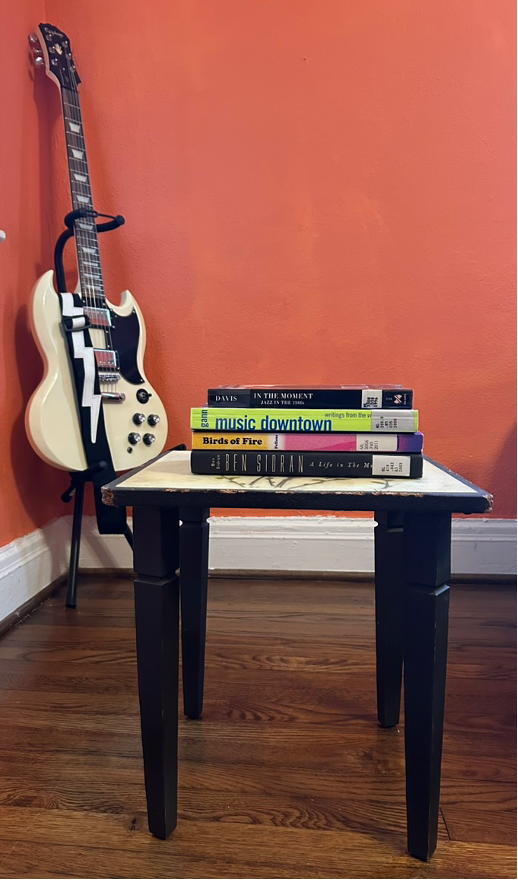
Ben Sidran - A Life in the Music (Taylor Trade Publishing, 2003): He only devotes five pages to New Visions, which is where I come in.
Francis Davis - In the Moment: Jazz in the 1980s (Oxford University Press, 1986): I particularly love his “Women’s Work” essay, in which he compels jazz fans to take vocalists seriously.
Kyle Gann - Music Downtown: Writings From the Village Voice (University of California Press, 2006): A sonic travel guide through a New York City that no longer exists, succinctly summarized by his observation that “Downtowners rejected the formality and implied upper-class status of both Uptown and Midtown music” (4).
Kevin Fellezs - Birds of Fire: Jazz, Rock, Funk, and the Creation of Fusion (Duke University Press, 2011): How’s this for a last sentence: “Most significant, fusion’s sounding out of the broken middle empowers individuals who do not fit neatly into given categories—or, more accurately, whose disheveled fit between categories allows them to challenge the displacements, misrecognitions, and histories that seek to silence them” (228).
Dan also recommended a collection of jazz studies essays that engage with media studies concepts like “authorship,” “art worlds,” “intertextuality,” “adaptation,” and “bad objects” from a different disciplinary perspective. I really wanna understand how VH1 and New Visions sounded, so I look forward to figuring out how to synthesize musicology with television history.
David Brackett, “Listening to Electric Miles: Creativity, Authorship, and Identity in the Jack Johnson Sessions,” Journal of Jazz Studies 15, no. 1 (2024): 1–38.
AJ Kluth, “Intertextuality and the Construction of Meaning in Jazz Worlds: A Case Study of Joe Farrell’s ‘Moon Germs,’” Journal of Jazz Studies 12, no. 1 (2019): 51–71.
Justin Williams, “Polystylism and Stylistic Adaptation in 1970s Jazz-Rock: The Case of Return to Forever’s ‘Duel of the Jester and the Tyrant (Part I & Part II),’” Jazz Perspectives 12, no 2 (2020): 181–205.
Charles D. Carson, “Listening Past Kenny G–Crossover Jazz and the Foregrounding of Black Sensualities,” Journal of Jazz Studies 14, no. 1 (2023): 35–46.