
Games without frontiers
Some thoughts about Marty Supreme’s post-war soundtrack

Disclaimer: This post contains spoilers
On the last Monday of 2025, I treated myself to a screening of Marty Supreme. Josh Safdie’s ambitious new film about a table tennis player based on Marty Reisman is a star vehicle for Timothée Chalamet, whose performance synthesizes the coiled intensity of Al Pacino in Dog Day Afternoon with the puckishness of Tom Cruise in The Color of Money. There’s also little bit of Matthew Broderick as Ferris Bueller in there too, particularly in a funny throwaway moment when a minor character congratulates Marty for a lie he told that got away from him. Save Ferris from himself.
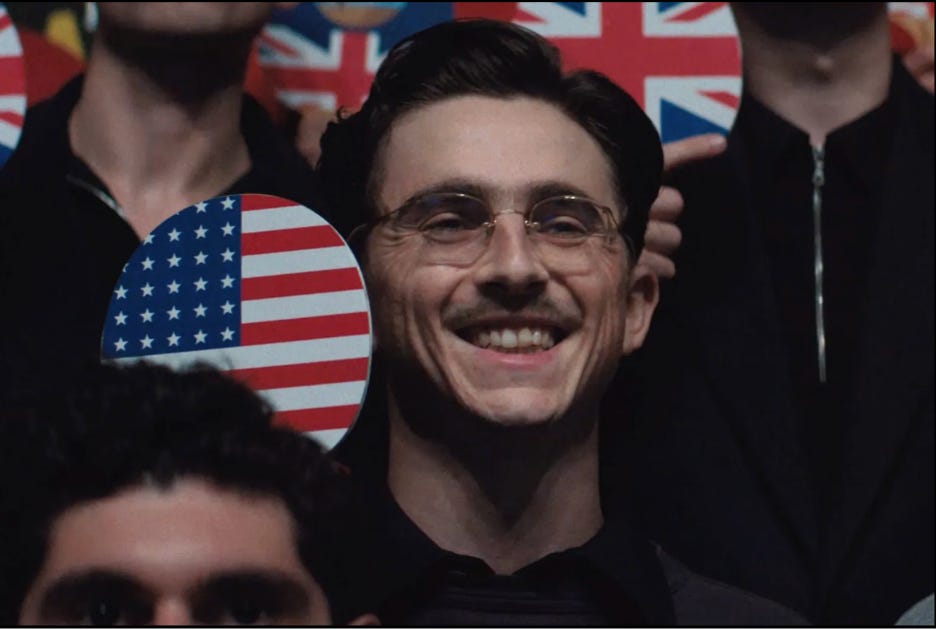
But I wasn’t there for Timmy. I was there for the soundtrack. Marty Supreme is set in 1952, but its musical sensibility owes more to 1982. These licensed songs are a catalyst for and an extension of score composer Daniel Lopatin’s borrowed nostalgia for the unremembered 80s. In his Letterboxd review, Jayson Greene chalks up its anachronism to “cocaine decisions—i.e. terrible ones,” which is very funny because he’s a great writer but <insert Howard Ratner gif> I disagree.
As a feminist pop music historian who submitted a term paper on Sofia Coppola’s New Romantic vision of Marie Antoinette to get into grad school, I have a lot of affection for anachronistic soundtracks. I like how they call attention to history’s constructedness, nonlinearity, and intergenerational reverberance. They can offer narrative commentary while freeing filmmakers from expository pitfalls. For example, Marie Antoinette astutely connects the Court of Versailles’ iconography to Adam Ant while critiquing their confectionery indulgences in relation to the UK’s Winter of Discontent, an economic crisis that fueled British post-punk’s resourceful experimentation and Marxist convictions. Coppola forges this connection in the opening credits, which pair Gang of Four’s “Natural’s Not In It,” a corrosive anti-consumerist screed, with a wide shot of the pampered queen getting dressed by a faceless assistant as she languidly swipes pink frosting from one of the many elaborate cakes surrounding her. After licking her finger, Marie Antoinette (Kirsten Dunst) breaks the fourth wall by smirking at the camera, an image that comments on the queen’s mythology while reveling in her trappings—or having your cake and eating it too.
Marty Supreme might owe more to Martin Scorsese and Abel Ferrara in its storytelling. But in a recent interview with Big Picture co-host Sean Fennessey, Safdie spoke at length about the film’s anachronistic soundtrack and went so far as to call it “a second screenplay.” In that sense, its motific use of British art rock to comment on Jewish-American assimilationism and the geopolitics of post-war athletic diplomacy reminded me more of Marie Antoinette. And also Theo Cateforis. In Are We Not New Wave? Modern Pop at the Turn of the 1980s, Cateforis argues that “the modern is ‘relational,’ rupturing with the immediate past and often turning to a more distant past as an inspiration of rebellion” (2011, 3). He demonstrates this by analyzing several new waves acts’ artistic temperament in relation to the developments of two other modern eras: the early 20th century’s emergent metropolitanism and rock ‘n’ roll’s coalescence with youth culture during its first decade. In other words, David Byrne’s anxious white male avatar emerged from the late 19th century’s evolving diagnosis of neurasthenia and his band’s bookish multiculturalism can be traced back to ethnomusicology’s problematic development of world music as a subject and object of critical inquiry during the early 1960s.
Marty Supreme is a character study about post-war neurosis and citizenship. What does it mean to strive to be the hero flavor in America’s melting pot when you’re kind of a jerk? Its soundtrack uses British art rock to foreground those themes through gameplay. With a few notable exceptions, most of the film’s anachronistic cues underscore table tennis sequences. The first act focuses on antihero Marty Mauser’s performance at the 1952 British Open and briskly moves through the tournament to Peter Gabriel’s “I Have the Touch,” a state-of-the-art slab of rock that propelled prog thrillingly into the 1980s. Safdie explained to Fennessey that he originally chose the song when he was studying British Open archival footage when he started working on the project. He put it on and “it just kind of worked. There was a feeling of that these people were ahead of their time in a weird way. That there was a modernity to seeing them against a different time period.”
Safdie later goes on to claim that the 1980s were “the first time culture was eating its own tail” by remixing the 1950s with films like Back to the Future. While there’s certainly a lot of the Roaring Twenties in the 1970s, Safdie’s larger point is illuminating for a number of reasons. Like post-war table tennis players, Gabriel was ahead of his time as a virtuosic electronic composer who helped mainstream instruments like the Fairlight synthesizer and the LM-1 drum machine. While Amy Skjerseth’s forthcoming book about presets will tell you far more about these revolutionary digital tools than I can here, Safie notes the soundtrack’s motific use of synth mallets is a foundational component of both Lopatin’s original compositions and the art rock song cluster. “Mallets,” Safdie says, quoting Lopatin, “is like ping-pong: ball, stick.” Amy interpreted this in our Instagram chat as an extension of “the Zimmer Effect,” or composer Hans Zimmer’s influence on contemporary scoring practices by synthesizing electronic and orchestral instrumentation into an evocative cinematic sound that rhythmically emphasizes diegetic events and objects. While I hear a bit more of Tangerine Dream in Lopatin’s output, Zimmer’s connection to post-war relations as a West German kid born a decade after World War II makes him an interesting resonator for Marty. He’s also a generation ahead of Alphaville, whose nuclear war power ballad “Forever Young” underscores Marty’s paternal transition during the opening credits. The soundtrack’s synth mallets turn Marty boundless ambition as a Jewish-American table tennis wunderkind who brags to the press about being “Hitler’s worst nightmare” and gets his friends and lovers tangled up in a traffic jam of slip-ups into a sound.
Synth mallets introduce this story, which begins with Marty on his grind as a salesman in his uncle’s shoe store on the Lower East Side. We hear a proclamation of “change” in the soundtrack. It’s sourced from the second single to Tears for Fears’ full-length debut, The Hurting. “Change” is one of the great songs about outrunning your friend because you can’t sit still. Though we only hear slivers of the song in the film’s opening sequence, its luminous rhythmic patterns vibrate with the mercurial glow of youth. “Change” always reminds me of the scene in Big where Tom Hanks taps out the melody to “Heart and Soul” on FAO Schwarz’s walking piano, except if Roland Orzabal and Curt Smith were trying to outrun each other in opposite directions. Marty’s life changes at the very beginning of the film when he impregnates his friend, Rachel (brought to life by Odessa A’Zion), during a stockroom tryst. When the pair fumble their way through a series of trials in the film’s digressive second act, Marty cruelly tells her that “I have a purpose” and she doesn’t. Marty might later replay his blithe dismissal of his lover’s potential with regret, as Smith does in the second verse when he looks back and realizes “I did not have the time/I did not have the nerve/To ask you how you feel/Is this what you deserve?” One thing I love about the first two Tears for Fears records is how young and wide-eyed the duo sound in their quest for wisdom. “Change” is all angles and pivots, like one of Marty’s pitches. I especially love the song’s bridge, which begins as a soul boy plea for an estranged friend and then transforms twice, first as a bed of percolating beats and then as a bratty post-punk guitar scratch. Orzabal plays like he’s trying to win an argument. He sounds 21.
Marty is a working-class neighborhood con man passing as an ambassador to the United States. In this way, table tennis’s function as a parlor game for post-colonial diplomacy is also gestured toward in the score and soundtrack. While Lopatin’s score merits its own examination, preferably with analysis that foregrounds ambient innovator Laraaji’s string and percussion work, Gabriel’s presence on the soundtrack as a Brit reinforces the country’s sovereignty within the film’s first act as the tournament’s host and the origin point in the game’s evolution from colonizing force to transnational sport. While Gabriel’s “Games Without Frontiers” is not on the soundtrack, its title references an international European competition show that dramatizes regular citizens’ efforts to represent their homelands through various games. In this way, table tennis served a diplomatic function in the early 1950s that anticipates anthemic art rock’s global consciousness in the mid-1980s. In his review of Gabriel’s breakthrough album, So, Eric Harvey refers to this as “rock’s NGO phase,” or “the moment when the world’s biggest superstars convinced themselves that doing their job bigger and more seriously could actually make the world a better place.”
Circling back to “I Have the Touch,” it’s not a surprise that Marty has trouble shaking hands at the end of a match. He’s an American. But he’s also representing America before time catches up to rock ‘n’ roll and John McEnroe. As a result, Marty approaches the sport very differently from his Japanese opponent, Koto Endo, played by deaf table tennis player Koto Kawaguchi. Endo is a focused player who wields his Atomic paddle like a blade. Marty runs, literally, on instinct. His strategy, on and off the court, is to hurl himself in front of the ball and keep it up in the air for as long as possible before he collapses. In the film’s third act, Marty flies to Tokyo to lose a rigged exhibition match to Endo for his sadistic sponsor’s amusement before he demands a rematch. He wins, and then wishes Endo good luck at the World Championship of a sport he has disallowed himself from playing on the international stage. A group of U.S. soldiers give him a ride home. In the final scene, he meets his newborn son in the hospital. Tears for Fears’ “Everybody Wants to Rule the World” plays over the end credits, a supervisory decision that turns a song about the Cold War into a meditation about what happens when children switch up the game of life.
Marty Supreme takes place just before 1955, the year that many critics and scholars pinpoint as rock ‘n’ roll’s big bang. Its director was born in 1984, the year that Michaelangelo Matos identifies as a turning point for pop music’s future. The closing credits divide the soundtrack into two decades—the 80s and the 50s—making the soundtrack, according to Eric Weisbard via Facebook, “both pre- and post-rock and roll.” The songs from the era are primarily situated within the film’s diegesis and prominently showcase Black band leaders like Dave Bartholomew and Johnny Ace. Bartholomew passed the baton to Fats Domino by producing “The Fat Man,” a song that Marty’s cab driver friend Wally (Tyler, the Creator) dances to at one point mid-getaway. This cluster of songs and their shared lineage with Tyler’s contemporary pop provocations illuminates another group of people who were ahead of their time: the Black musicians who invented rock ‘n’ roll. They may not be as sonically declarative as the art rock songs, but they also gesture toward another nascent form’s interracial friction during its first decade. Sports serve a similar function in Marty Supreme as a tool for integration. Marty and Wally jocktagonize each other while playing table tennis in a parlor owned by Lawrence, an older Black gentleman played by former basketball player George “Iceman” Gervin.
One detail I find interesting about Safdie’s creative journey with “I’ve Got the Touch” is something he revealed in an interview with Chris LeFault on IndieWire’s Filmmaker Toolkit podcast: apparently he annoyed his wife by playing it on a loop. This personal detail made me wonder what Safdie’s wife, producer Sara Rossein, thought of the soundtrack and, perhaps simplistically by extension, how we understand Rachel in relation to Marty Supreme’s pre- and post-rock ‘n’ roll soundtrack. I really like A’Zion’s flinty performance, but I’m not sure what to make of her character. Marty doesn’t know she’s pregnant until he returns home from an international tour with the Harlem Globetrotters and spends much of the film denouncing his paternity, perhaps as his offscreen absentee father did before him. The film doesn’t seem particularly curious about what she was up to while he was gone beyond deflecting suspicion from her husband, Ira (Emory Cohen). Perhaps that’s the purview of If I Had Legs I’d Kick You, a story about a mother on the verge of a nervous breakdown written and directed by Safdie’s cohort mate, Mary Bronstein. As Marty tries to pay off his outstanding fine to the International Table Tennis Association through a series of failed con jobs, Rachel seeks refuge from Ira’s abuse. Marty begrudgingly finds shelter for her and she tries to help him find a lost dog in a stressful subplot that scans as a dry run at parenthood. But then Marty finds out Rachel has a fake black eye and kicks her out, forcing her to reveal to Ira that he is not the father of her child.
Her confession, and Ira’s subsequent violent outrage, is intercut with footage of Marty practicing that is synced to New Order’s “The Perfect Kiss.” This seems to be the moment that the pair commit themselves to each other, but I’m not sure how to feel about their relationship. Rachel’s fake black eye makes me as queasy, especially when a palpable threat of harm hovers over her when she finally tells her husband what he already knows. But the person who comes to her aid is Marty’s mother, Rebecca (Fran Drescher, great casting). She seems to be the person Marty’s outrunning and turning the mother of his child into. One of my favorite shots of the whole film is a searching look Rebecca gives her son when he returns to Rachel at the hospital.
But who is Rachel? At various points, she’s likened to or passed off as Marty’s sister. And perhaps that’s why “The Perfect Kiss” bugged me, even though it’s one of my all-time favorite songs by a band who’s music was also used evocatively in Marie Antoinette. Rachel doesn’t get her own sonic sensibility because she’s tied to Marty. I get it; they’re partners. She’s got a mean backspin. As I watched Rachel drive and block, I thought about British feminist post-punk’s austere examinations of domesticity’s violent constraints upon women. I thought about The Raincoats’ “Off Duty Trip,” a harrowing song inspired by a news story about a soldier whose military status freed him from a rape conviction that Jenn Pelly describes in her 33 1/3 book about the band’s eponymous debut album as having “a charred and halting mood, as if you’re pausing every few feet to look over your shoulder on a late-night walk home” (2017, 127). I thought of Au Pairs’ cover of David Bowie’s “Repetition,” a disquieting song about intimate partner abuse that takes its chorus from the assailant muttering that “he could have married Anne in a blue silk blouse” instead of the unnamed woman he hates. Perhaps such unvarnished songs clash with the film’s sleek bombast. But why can’t Rachel have her own sound?
This is a lovely take on asynchronous soundtracks and the homologies between Marty’s post-war US globalism and the new wave/synth soundtrack of the Reagan 80s. It makes me think of my favorite asynchronous soundtrack: John Sayles’ 1983 teen romance Baby It’s You, which I’ll go on about at some length with your leave.
The story unfolds in the mid-60s, with Roseanne Arquette’s Jill coming of age from a privileged, vaguely rebellious high schooler to a proto-feminist college girl, and the diegetic soundtrack moving from girl-group confections like “Chapel of Love” to Simon and Garfunkel and the Velvet Underground. Meanwhile the action is punctuated by four non-diegetic Springsteen songs, one from each of his first four albums, with each accompanying a key scene centered on Jill’s bad-boy love interest, known only as “the Shiek” (played by Vincent Spano). Though the narrative is mostly restricted to Jill’s perspective, these scenes give Spano’s character more agency; I tend to read the Springsteen songs as functioning in the manner of a nostalgic voiceover like that of Stand by Me or The Wonder Years, i.e. as reflections on the action from the perspective of an older version of the Shiek, or maybe of Sayles himself. Springsteen’s songs work perfectly in this context as so many of them work as past-tense renderings of rock nostalgia; as the nattily dressed Shiek checks his look in the mirror before entering the school lunchroom with all eyes on him, we hear the opening strains of “Saint in the City”: “I had skin like leather and the diamond-hard look of a cobra …”
At the tail end of the film’s second act, Jill goes into a bar looking for the Shiek and spots him across the bar with another girl. The camera lingers on Jill as the sadness and wisdom of his betrayal set in, while the Chiffons’ “Sweet Talking Guy” plays on the jukebox – or so it does on the VHS tape. In the theater, it was the Toys’ “A Lover’s Concerto,” one of the very first songs I can remember hearing (and loving) on the radio, circa 1965. I assume the producers couldn’t get permission for that song beyond theatrical release, and I think the Chiffons song works pretty well. But wow, like we so often do when we become attached to a certain soundtrack for a certain film, boy do I miss that Toys song. The Chiffons make the point for Jill on the nose: the Shiek was a sweet-talking guy whom she’d do well to stay away from. But “A Lover’s Concerto,” composed to the melody of the prettiest Bach minuet, its syrupy lyrics sung by the Toys’ Barbara Harris with such conviction that she almost convinces you this love could go on “from this day until forever,” works even better.