
Girls' only daughters
Some thoughts on Hannah, Marnie, Shosh (& Jessa)

Last week, I read Lena Dunham’s new memoir, Famesick, for a book chat with some friends. Dunham’s sequel to Not That Kind of Girl examines various phases of her adult life, which have been both dramatized and satirized in her feature debut, Tiny Furniture, HBO’s Girls, and last summer’s Too Much. She also speaks with bracing candor and ingratiating wit about her various professional, interpersonal, and health struggles as she stumbled through her 20s and 30s (she just turned 40—honey, welcome to my box). While I’ve always been weary of Dunham’s filigreed hipster affect, I found myself moved by her reflections on her recent past in the spotlight and the toll it took on her body and her relationships. In particular, her fallout with former creative partner Jenni Konner bummed me out. Of course, I’d like to hear Konner’s side of the story, particularly as someone who has been mentored by women and wants to practice non-toxic mentorship as I age. But Famesick made me reflect on the show they made together, and how hard it can be to hold onto people as you move through the peaks and valleys of your own life.
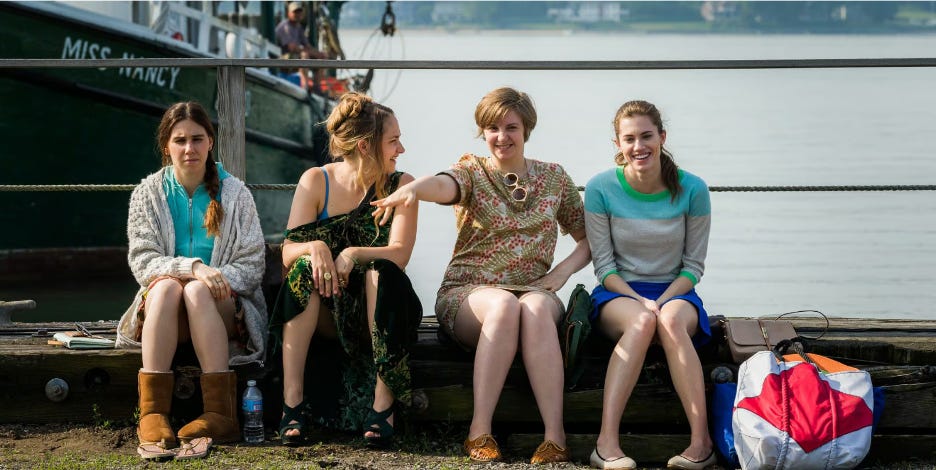
One of Girls’ enduring contributions to popular culture is its nuanced depiction of the slow dissolution of a friend group after college. Its closest spiritual precursor is Noah Baumbach’s Kicking and Screaming, a wry character study about a bunch of guys who stay on campus after graduation because they’re too scared to leave. Inevitably, Grover and Max will lose touch with Otis but the story ends before that happens. Several television shows avoided this fraught interpersonal reality at all costs for syndication’s sake. Ross and Rachel are endgame, even as each breakup makes them hate each other more. Ted has to be with Robin, I guess. Jerry and the gang end up in prison after alienating everyone around them. Popular feminism advanced #squadgoals as a paradigm for female homosocial bonding. Kim Catrall’s absence from And Just Like That… revealed the toxic dynamic at the heart of the Sex and the City franchise. Girls, by contrast, examined the various disagreements, rivalries, and estrangements between Hannah (Dunham), Marnie (Allison Williams), Shoshanna (Zosia Mamet), and Jessa (Jemima Kirke) because an unfortunate obstacle to women’s equality is that we don’t all fuck with each other.
Girls premiered on HBO in April 2012, while I was wrapping up my first year of graduate school. I turned 29 later that summer. Girls was the first time I experienced a pop culture phenomenon about people who were a microgeneration younger than me. As I moved through their erotic misadventures, shitty apartments, and fashion missteps, I thought about my previous decade in Austin. The night before my partner and I moved to Madison, I watched Richard Linklater’s Slacker in our unfurnished living room, quietly mourning a version of the city that no longer existed and a transient way of life I was outgrowing. I also taught my first cohort of college students that school year. As I watched them sit together, pair off, coordinate class schedules, and move into off-campus housing, I smiled knowingly and hoped for the best.
Another thing that resonated with me about Girls was that it’s a show about only children struggling to cultivate and maintain friendships with each other. As a media scholar and only child, I’ve long filtered my reception of television and film through our perspectives. We often exist by default—likely the accidental byproduct of a screenwriter’s oversight or a production’s limited budget. We tend to show up in horror films and erotic thrillers as manifestations of familial trauma and marital dysfunction. Some shine and some don’t. We are often sons, although shoutout to my girl Ellen who survived a kidnapping in Fatal Attraction. When I was a kid, I was often asked to justify my sibling-free existence to nosy adults. In those moments, I felt pressure to stick up for my mom—a protective instinct that deepened in my 20s when I found out that she suffered a series of miscarriages in aggrieved silence when she was my age.
Only childhood seems more normalized now, likely an intentional byproduct of our generation’s financial precarity. That normalization has gradually been reflected in popular culture. Girls exists in a Brooklyn Millennial multiverse with Broad City, a buddy comedy in which introverted only child of divorce Abbi (Abrams/Jacobson) is often the foil to Ilana (Wexler/Glazer), the extroverted baby of her nuclear family. My favorite only child friend group is King of the Hill’s Rainey Street gang because I like how distinct Bobby, Connie, and Joseph are from one another. Bobby doesn’t have any siblings because of his father’s narrow urethra, a source of shame that results in his mother babying him well into adolescence while his father endlessly frets about whether both of them are man enough. Connie, named Kahn Jr. after her father, is a first-generation Laotian American daughter who shoulders the weight of her immigrant parents’ dreams and expectations. Joseph is the biracial product of his white mother’s affair with a Native American healer that his paranoid father either doesn’t notice or (more likely) willfully denies.
Like King of the Hill, Girls uses seriality and observational humor to examine how Hannah, Marnie, and Shoshanna differ from each other as only children because of their upbringings. The series closely follows Hannah’s relationship with her parents, Tad and Loreen (Peter Scolari and Becky Ann Baker). I always found it interesting that Dunham wrote her character as an only child, given the difficult relationship she has with her younger sibling Cyrus. Hannah is the only girl in the quartet whose parents are still together at the beginning of the series. They are so involved in their daughter’s life that she claims they “never gave me any space to even read a book.” Even though they live in East Lansing, they visit her often and regularly call to check in. They are also faculty members at Michigan State. While I may quibble with the timing of Loreen’s tenure,[1] her daughter very much reads as a faculty kid: precocious and intellectually curious but striving to live a life of the mind on her own terms. Though Tad and Loreen have misgivings about Hannah’s progress, they ultimately support her pursuits as a writer. In hindsight, their focus may also be a symptom of repressed marital dissatisfaction. By the end of season four, Tad comes out as gay and Hannah has to negotiate her parents’ atomized undivided attention. But at the end of season two’s “Video Games,” Hannah processes a harrowing glimpse at Jessa’s broken extended family by calling to thank her parents for extending a level of support she likens to “a hammock under the Earth that’s protecting me.” Loreen accuses her of needing something, an aggressive act that Tad placates. While this scene illustrates their codependency, Hannah’s parental support emboldens her to take creative risks that her friends can’t or don’t.
Then there’s Marnie, who self-identifies as Hannah’s best friend. They’re a study in contrasts as two only children who internalized very different forms of helicopter parenting. Marnie was ostensibly raised by her mother, Evie (Rita Wilson). They mention her unnamed father in passing, often revealing vivid character details like a sex addiction “that was fun for a while” for Evie before it destroyed their home. We never see him. He doesn’t even show up to Marnie’s wedding in season five. His absence, coupled with her mother’s intense critical scrutiny of her life and especially her appearance, create a poignant context for Marnie’s perfectionism and love addiction. Her beauty is supposed to make things easy for her, but her fastidiousness boils over into entitled rage. Throughout the series, she invests so much hope into serial monogamy and a great job and deeply resents when neither of those markers of stability immediately materialize or ignores a field of red flags to settle for a facsimile of what she wants. When she’s unfulfilled, she picks at people. Frequently, she applies her mother’s fixation on her beauty by imposing a standard of self-improvement onto Hannah that purposely leaves her perpetually disappointed. One of the meanest things she ever says about Hannah is when she pays her a compliment at her twenty-fifth birthday party by saying “she could look like this every day if she wanted.”
Finally, we have my girl Shosh. What’s fascinating about her to me if how much we have to interpret about her backstory that isn’t in the text. When we meet her, she’s an NYU student and—implausibly—Jessa’s cousin.[2] Dunham has recently taken to identifying herself as a Shosh. I mean, I’m sure she’s all of the Girls except Marnie. Shosh is probably the part of Dunham that got Girls on the air. Taylor Swift has long self-identified as a Shosh. Dunham thinks she’s more of a Marnie, which seems like an observation Hannah would make. Shosh is presented as a chatterbox with boundless ambition, but I identify with the anxiety undergirding her breathless recitation of various goals and affirmations. Like Marnie, she’s a status-obsessed only child of divorce. Unlike the other girls, Shosh doesn’t mythologize herself as much. Or, more accurately, the other girls ignore her because they’re more interested in themselves. She’s also the youngest group member. Her facility with older friends, including cranky ex-boyfriend Ray (Alex Karpovsky), registers to me as a sign of parentification. Girls dedicated entire subplots to Hannah’s parents. Marnie’s mom is a recurring character. But we only see Shosh interact with her parents once in a brief but illuminating scene. At the beginning of season four, Shosh picks up her diploma after finishing some outstanding credits over the summer that kept her from graduating with her classmates. Her father Mel (Anthony Edwards) is there with camera in hand, while her mother Mel (Ana Gasteyer) shows up in a huff over missing her daughter’s symbolic passage into middle-class adulthood. Shosh tries to downplay her own disappointment and uncertainty by tensely reassuring her mother that “you didn’t miss anything, there’s nothing to miss.” Her parents talk over her the entire time. She’s also on her way to Marnie’s jazz brunch, which doubles as Hannah’s farewell party for a brief reprieve at the Iowa Writers’ Workshop. Ray is the only person who congratulates her for finishing college, or even seems to notice.
Shosh delivers some hard truths in a climactic fight at the end of season three’s “Beach House.” In this episode, Marnie masterminds a North Fork getaway to “prove to everyone via Instagram that we can still have fun as a group” but offers the girls no say on the itinerary, the menu, or even the room assignments (I call dibs on the lighthouse). Hannah, ever the contrarian, runs into her gay ex-boyfriend Elijah (series MVP Andrew Rannells) and invites his friends over to avoid having a Marnie-sanctioned heart-to-heart with the girls at dinner. They get daydrunk and learn a dance routine that devolves into a fight when Marnie insists they do it again because she thinks Hannah messed it up. What’s great about this fight is that they’re both wrong. Hannah should’ve touched base with Marnie first, but didn’t because she knew she’d say no. Marnie should’ve scrapped an elaborate gourmet duck dinner for a meal her friends actually wanted to eat. What’s also great about the inciting incident is that Marnie wants their group choreography to be “as close to perfect as possible,” while Hannah’s okay with it having “a lot of spirit.” Jessa, who effortlessly nailed the routine, tries to play peacemaker by siding with Marnie. This alliance plays on Hannah’s insecurities about their beauty, a rift that opens into a chasm when Jessa dates Hannah’s ex Adam (Sackler/Driver) in season five.[3] It also briefly flatters Marnie, who is threatened by Jessa’s friendship with Hannah and hip insouciance. After all, her “Laurel Canyon Classic” wedding is a meticulously curated version of Jessa’s surprise ceremony in season one. But it’s Shosh who sees this dynamic most clearly from the outside. She rolls her eyes at Jessa’s rehab wisdom. She challenges Hannah’s pretentious dismissal of her “unstimulating” personality. And she reads Marnie for being “tortured by self-doubt and fear, and it is not pleasant to be around.” She’s been quietly seething in the background all day, possibly for years.
What I’m struck by in this scene is the difference between how others perceive Shoshanna and how she perceives herself. She claims that “You guys never listen to me. You treat me like I’m a fucking cab driver. Seriously, you have entire conversations in front of me like I am invisible. And sometimes I wonder if my social anxiety is holding me back from meeting the people who would actually be right for me instead of a bunch of fucking whiny nothings as friends.” This is a harsh yet revealing self-assessment. Maybe Shosh talks a mile a minute because she doesn’t know how else to interject without preparing a monologue in her head first. Her dismissal of the girls as “whiny nothings” exposes an unflattering superficiality, but it’s also a direct articulation of need from a young woman hungry to channel her energies into a mutually supportive friend group. Finally, it hints at how hard she is on herself. In season five, she relocates to Japan for a marketing job and stays long after she’s been downsized because she’s the kind of person who internalizes an unstable job market as a personal failing. Girl, late capitalism is not your fault.
“Beach House” is Girls’ best episode. It’s the series in miniature and also its turning point. In the first half, the girls try to hold onto each other. In the second half, they drift apart. Shosh officially removes herself from the group in the penultimate episode. But they could never recover from their North Fork fight. Hopefully, they don’t make the same mistakes with their new friends.
[1] If Girls had hired me as an academic consultant, I would have advised them to rewrite “Tad & Loreen & Avi & Shanaz” to be about Loreen stepping down as chair or retiring instead of getting tenure in her twilight years. Based on substantial anecdotal evidence, I maintain that Loreen and Tad got tenure by the time Hannah started middle school.
[2] If I were to retcon a crucial part of Girls lore, I would have Marnie integrate Shosh into the friend group as a wide-eyed gallery intern she tries to make over in her image à la Cher Horowitz.
[3] I’m a Jessa/Adam truther. As addicts with abandonment issues, they’re the Girls couple that makes the most psychological sense to me. It’s also why I worry about them, because they cannot fix each other.