
Lipstick traces
Some thoughts about communing with Courtney and Madonna

I’ve recently started throwing on a playlist of RuPaul’s Drag Race lip sync battles at parties. Even thought I usually hang with my friends in the backyard, it’s nice to have them on in the background. But perhaps I should host a viewing night, because I regularly queue up some of my favorite performances whenever I need a dopamine boost. It’s always thrilling to see queens push each other to step their pussy up, as Anetra did when she showed Marcia Marcia Marcia who’s “Boss B*tch.” It’s also great to see comedy queens wield humor as a tactic against fierce dancers, as Jane Don’t and Megami did when they faced off against the House of Dion. Sasha Velour raised the stakes on lip sync battles with a surprise wig reveal for Whitney Houston’s “So Emotional” that cost Shea Coulée the crown. The cascading rose petals may have given Sasha the edge, but all of the best lip syncs compel a queen to have an emotional connection with the song, as Jujubee, Alexis Mateo, Dida Ritz, and Latrice Royale all demonstrated in early seasons.
During All Stars 7, the show staged its first and only spoken word lip sync battle when Monét X Change and Jinkx Monsoon performed Julia Sugarbaker’s “The Night The Lights Went Out in Georgia” monologue from Designing Women. Both queens nailed Sugarbaker’s clipped grandiloquence, but Monét won by serving cunty church lady realness in a divine yellow skirt suit. I’d love to see the queens do this more often to honor performers like Lypsinka, who elevated lip syncing into an art form. One scene I’d like to see queens interpret is Courtney Love hijacking Madonna’s MTV News interview after the 1995 VMAs. Love interrupts Madonna’s conversation with Kurt Loder by throwing a MAC compact at her. What follows is a walking study in demonology. Love, disheveled in a lacy black minidress, dishes it. Madonna, channeling Peggy Lipton for Gucci in a blue silk shirt and black hip huggers, gives it right back. Love compliments Madonna for signing Alanis Morissette to Maverick, then needles her about her band’s unsuccessful meeting with the label. They make fun of host Dennis Miller, then admit that they have a thing for funny guys. Love teases Madonna for “dip[ping] into the population,” then compares dating rock stars to working with surgeons. Madonna advises Love to “get out of the hospital.” Love demurs: “I like it here. Nice clothes, good money—” “…And a lot of available drugs,” Madonna replies knowingly. They compare shoes before Love recalls seeing Truth or Dare on a date with Kurt Cobain, who saw a kinship in Love and Madonna’s blonde ambition. Madonna kisses Love goodbye as she flees the scene, then Love takes over the interview.
I was fortunate enough to witness this moment after coming home from junior high open house. My parents had just gotten cable, and MTV was my night light. Music videos provided a wider range of femininity than Seventeen could. Björk was my north star—resplendently odd as she danced on a flatbed truck, through a forest, and in the San Fernando Valley. She showed me how to move through life. Missy Elliott joined her the summer before high school. Madonna and Janet Jackson were more aspirational figures for me. I could never dance as well as them, but maybe I could access their poise and confidence through osmosis if I just kept watching.
Love, on the other hand, represented something more volatile: chaos. I never knew what move she was gonna make. The music video for Hole’s “Violet” showcases Love’s relationship to dance. As a teenager, Love was legally emancipated from her dysfunctional family and supported herself by stripping. “Violet” juxtaposes ballet with burlesque. Love is first presented as a punk ballerina, then introduces the second verse with a pole dance. The video filters both dance forms through a leering male gaze. The connection never occurred to me, nor did their shared athleticism. This might have also been the first time that I had seen women make out on screen, as the outro includes four dimly lit shots of two women (possibly Love?) rolling around on a bed.
But Love really came alive for me during interviews. She was whip smart, digressive, and disarmingly funny. Charisma as performance art. I pored over her transcribed conversations in magazines. She frequently spoke to Rolling Stone and Spin, but I was particularly struck by Kevin Sessums’s Vanity Fair profile of her after Cobain’s death, a harrowing yet triumphal portrait of a single mother’s grief. Among other things, I learned that medieval widows planted their husbands’ hearts in oak trees. I later learned that it was a big deal for Love to talk to Vanity Fair after Lynn Hirschberg’s damning feature on her and Cobain prompted CPS to investigate them. I knew she was a big deal when Barbara Walters interviewed her. She wore a lavender suit and an updo, good girl drag. But she fidgets and smokes. She gets defensive when she’s in a feisty-ass mood. At one point, Walters asks Love whether she’s a good musician. Love sticks up for her band: “We’re really good, and that might sound arrogant and I’m sorry. It’s just the truth.”
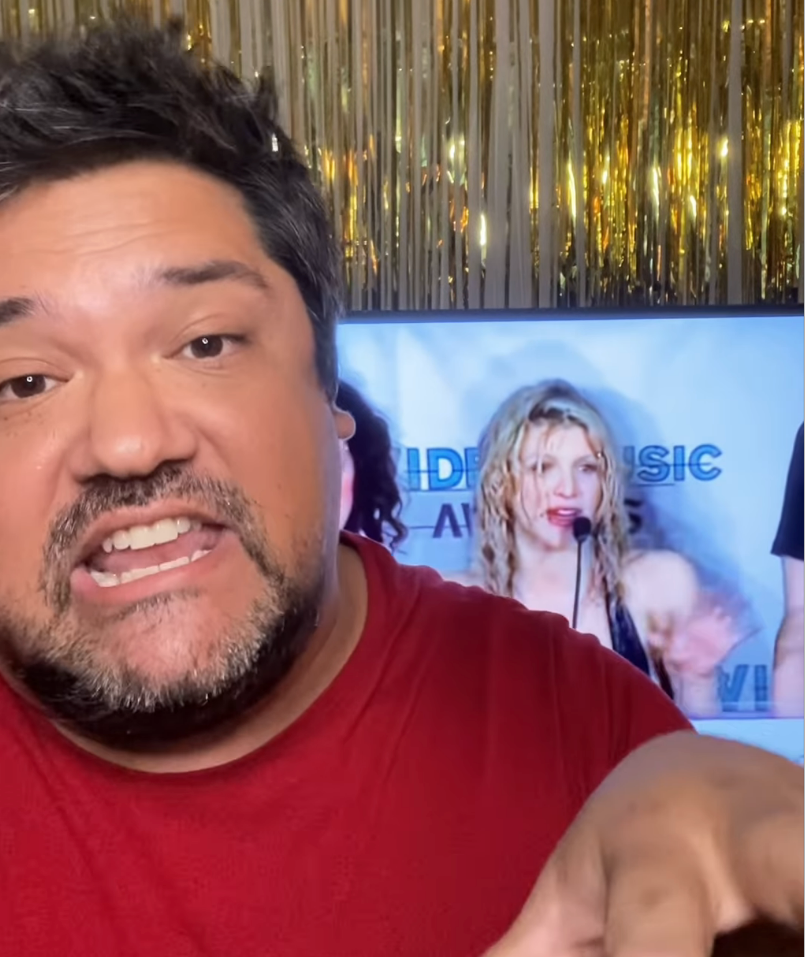
I’ve studied this interview for years. So has Nick Cisnero, who nails every cadence and gesture. I started seeing his Instagram reels pop up on my feed last spring. Many of his videos are reenactments of iconic white lady histrionics, like Linda Partridge’s drug store breakdown in Magnolia. He performs these scenes in front of a flatscreen monitor that replays the moment he’s recreating. A curtain of gold streamers heightens the makeshift camp. These videos reverse karaoke staging by putting the information the performer sees on screen behind him. But he’s not performing to an instrumental track. He’s performing with these women. I love how he interprets Love’s nasal rasp through his own voice. His reenactments are duets. The layered voices sound the profound parasocial connection that some gay men have with unruly women. Listen to the music Cisnero makes out of Love’s 1998 VMA press conference, her Nicole Kidman story on Letterman, that time when she compared herself to Cher on MTV News, or that time when she warned starlets to steer clear of Harvey Weinstein at Comedy Central’s Pamela Anderson roast.
Bandsplain’s recent series on Madonna has explored how gay men and femmes bond over divas to help us see who we are and who we want to be. Host Yasi Salek explored Madonna’s early years with Mel Ottenberg, her iconoclastic turn with Patrik Sandberg, her spiritual rebirth with Paul Hamann, her late period with Caryn Ganz, her film career with Big Picture hosts Sean Fennessey and Amanda Dobbins, and her wide-reaching fanbase with her mother Fattaneh. In the episode that maps Madonna’s trajectory from Like a Prayer to Bedtime Stories, Sandberg reveals that he’s in several Madonna group chats with Ottenberg, Hamann, and other gay men and that Ganz, a veteran music critic who recently said bye bye baby bye bye to the New York Times, is Mother. He also considers how friction is an integral part of diva relations by discussing the CBS This Morning interview in which Cher called Madonna “a cunt,” a passage he recites from memory that Madonna included in one of the clip packages for her Celebration tour. This episode also delves into how Madonna used her stardom to advocate for HIV awareness and prevention at the height of the AIDS crisis, like including educational information about contraction in Like a Prayer’s liner notes. Of course, Madonna was not the only pop diva to raise alarm about the plague. Patti LaBelle became a spokeswoman for the National Minority AIDS Council in 1987. But these women used their voices to talk back to an indifferent federal government who let their friends, colleagues, and fans die because they were gay or trans. As they fought, younger queer people benefitted from their pushback. Sandberg speaks poignantly about what Truth or Dare meant to him. He was transfixed by Madonna’s dancers, some of whom were HIV-positive, because they were the first gay male friend group he had ever seen.
Cisnero has also produced several Madonna reenactment videos, including her 1992 interview with Jonathan Ross where she discusses her interests in bisexuality and homosexuality and calls upon gay celebrities to come out to help destigmatize queerness. Five years later, Love used a VH1 Fashion Awards acceptance speech to proclaim that “keeping gay people in the closet with our attitudes and our actions is cruel and it’s tacky, and most of all, it’s boring.” She also thanks her glam squad, which included some of Madonna’s collaborators. Salek notes that Love introduced Madonna to designer Arianne Phillips during their “Women of Rock” Rolling Stone photo shoot with Tina Turner. Every queen knows it takes a village to be fabulous. They also know that there’s no shame in borrowing another girl’s outfit to turn a look when the children are watching.