
One Oscar after another
Some thoughts on the 98th Academy Awards

The Oscars took place last night at the Dolby Theatre, concluding a particularly long and unpredictable campaign season. I watched from my living room, as I have in some configuration since I was allowed to stay up to watch Schindler’s List win Best Picture in 1994. To me, the frontrunners were among the best crop of American movies and mainstream foreign imports I’ve seen since Parasite became the first non-English language film to win Best Picture in a pre-COVID 2020 or since the heady days of 2007 when There Will Be Blood and No Country For Old Men held a cracked mirror up to the waning days of the second Bush administration.
Sinners and One Battle After Another led a vibrant cohort of films that Wesley Morris recently described as “the conflation of the present with many, many, many different pasts.” He was referring specifically to the two films referenced above, along with Marty Supreme and The Secret Agent. Taken together, these movies use the past—1932 in the Mississippi Delta, 1952 in the Lower East Side, 1977 in Recife, and the last 16 years in an alternate reality Northern Californian sanctuary city—to show us how power continues to make, undo, and remake us. Two colleagues eloquently surmised the evening’s complementary narratives. My neighbor Landon Palmer eulogized the end of an era by congratulating Warner Bros., the studio behind Sinners and One Battle, for winning 11 Oscars before getting gobbled up by Paramount and the Ellisons. Jennessa Hester noted that Sinners and KPop Demon Hunters “have very similar ideas about music—how it is intimately tied to culture and identity; how it can transport us forward and backward in time; how it functions as an aesthetic force to fight evil and oppression.” They’re both right. In case you missed it, here are my highlights.
Conan O’Brien was reliably great as host. The cold open, in which he ran through a bunch of movies and into the auditorium in Gladys Lilly drag, remixed Billy Crystal with peak MTV Video Music Awards with the best deployed “Sabotage” needle drop since Steven Soderbergh’s Kimi. He deftly knifed 47 in the back with an Epstein joke. He debuted a “Timmy bum drum” bit that recalled his patter with Max Weinberg. Some of the Gen Z pandering was goofy, but at least we got “hostmaxxing” out of it. He kept the show moving along and forward, coming out when necessary to point out when history was made while never letting the Academy take itself too seriously. Say what you will about the broadcast model or white men hosting talk shows, but using light humor to set the tone for an award ceremony is a dying art that I’ll miss when it’s gone.
Speaking of Weapons, I was sad that Teyana Taylor lost Best Supporting Actress to Amy Madigan. Her performance as Perfidia Beverly Hills became a political football for Black representation that I felt threatened to reduce, eclipse, and undermine the dynamic and complex work she did in One Battle After Another alongside Regina Hall, Chase Infiniti, Shayna “Junglepussy” McHale, April Grace, and Starletta DuPois. I also dislike how the Oscars set up a trap of comparison between Taylor’s performance as Perfidia and Wunmi Mosaku’s characterization of Annie in Sinners. And I wish that more people talked about Perfidia’s struggles with post-partum depression alongside white Best Actress nominees Jessie Buckley and Rose Byrne’s depictions of aggrieved motherhood, but I appreciate how Angelica Jade Bastién interrogated that thematic connection across the color line. Taylor is a star who I hope we continue to see kick ass and shine bright.
That said, I’m annoyed that Sean Penn now has three Oscars and Delroy Lindo still has none. Penn’s grotesque Steve Brodner caricature of a military officer sucks up all of One Battle’s oxygen and indulges Paul Thomas Anderson’s sophomoric screenwriting impulses. His costar Benicio Del Toro did far more nuanced work. Hollywood tells on itself when it over-rewards “bad boy” Method actors who play cartoons over journeymen character actors who refuse to condescend to the characters they’re given to inhabit.
Speaking of Sinners, I love the ceremony’s recreation of the film’s divisive “juke joint time portal” sequence with Brittany Howard and Raphael Saadiq. Carl Wilson decried it as “the stuff of old iPod ads or CNN faux-documentary montages made for a social-studies teacher” and fair enough. Admittedly, I cannot divorce it from the context in which I originally saw it, at a local theater and behind a student with whom I had recently unpacked a quote in class from Emily Lordi’s The Meaning of Soul about soul music as “a capacious narrative of black overcoming that illuminates an eclectic set of musical aesthetics and signals unexpected futures” (2020, 15). As a musical theater kid and a history teacher, I appreciate that Coogler took a swing that we can take up as a lesson.
Speaking of history, my favorite film of 2025 was Kleber Mendonça Filho’s The Secret Agent. It’s a vibrant panorama of life during Brazil’s military dictatorship that vividly dramatizes authoritarianism’s weaponization of misinformation against collective memory. It’s at once a political thriller, a social melodrama, a folk tale, and a monster movie. It was also completely shut out of Best Picture, Best Actor, Best Casting, and Best International Film despite being the film of our time. Brazil in the 70s has a lot to teach the United States in its current moment. If you left One Battle hungry for more of Sensei Sergio St. Carlos’s communitarianism, watch this movie immediately. It’s on Hulu.
For the record, I’m not mad that Sentimental Value won Best International Film. It’s a beautiful Norwegian family melodrama about a father (Stellan Skarsgård) who can only tell his adult daughters that he loves them by making a movie about his depressed mother and roping them into the production. I’m sure Gustav Borg’s plight resonated with several middle-aged white male voters, some of whom may have also shared mature arthouse fare like The Piano Teacher and Irreversible with their grandchildren before they were old enough to metabolize it. The Secret Agent just fed me more.
This year, the Academy introduced Best Casting as a new award and gave its inaugural prize to One Battle’s Cassandra Kulukundis. Next year, they’re adding another category for Stunt Design. That’s great! The more that the Academy recognizes below-the-line labor, the better! I’d like to add an award for Best Music Supervision and give it to Gabe Hilfer for Marty Supreme. I would have also nominated Daniel Lopatin for its score and given Jack Fisk his first (!) Oscar for the film’s granular production design. For what it’s worth, the Guild of Music Supervisors recognized Hilfer’s work earlier this month.
Speaking of music, I’m glad KPop Demon Hunters won Best Animated Feature and Best Original Song for “Golden.” I thought about writing a post on the film, but all of my reference points (Josie and the Pussycats, The Powerpuff Girls, Teenage Mutant Ninja Turtles, Bob’s Burgers) betray a Western bias that cannot move the discourse forward. The editor in me would much rather read K-pop studies scholarship on the film and its soundtrack as a global phenomenon. May a thousand syllabi and anthologies bloom!
I was moved by the extended “In Memoriam” segment to commemorate all the talent we lost. It started with Billy Crystal eulogizing Rob Reiner, continued with Rachel McAdams paying tribute to Diane Keaton’s influence on multiple generations of actresses, and culminated in Barbra Streisand singing “The Way We Were” for Robert Redford. The mix let her down—I’m sure she had notes for the sound team. But you know Barbra loves you if she’s willing to sing live on stage to celebrate your memory.
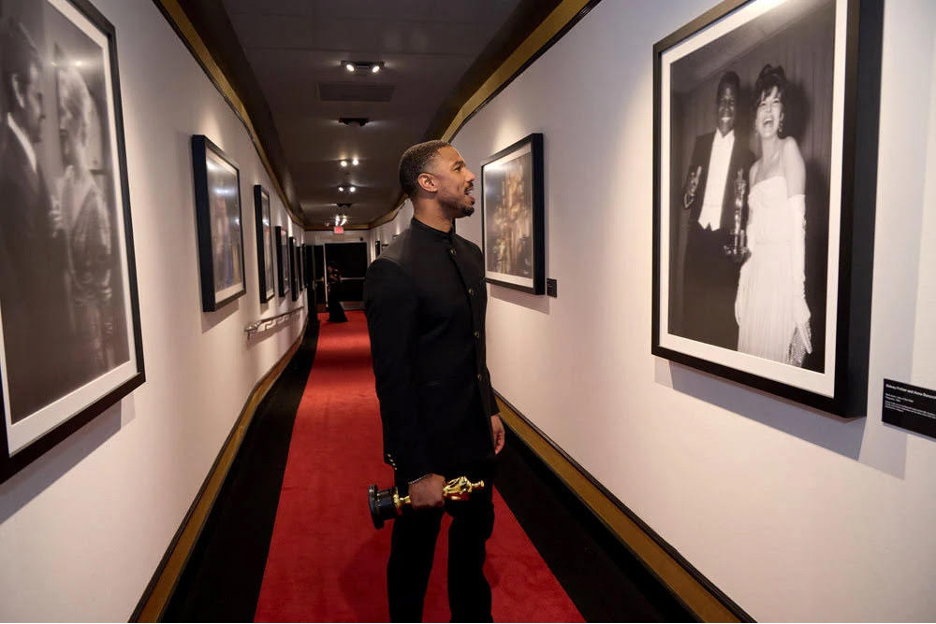
I’ll conclude with my two favorite speeches of the night. First off, congrats to Sinners’ cinematographer Autumn Durald Arkapaw—the first woman to ever be recognized in the category’s history. Second, I was really impressed with Michael B. Jordan’s speech for Best Actor. Until the Actors Awards, pundit logic dictated that it was Timothée Chalamet’s award to lose. I like both performances, but bristled at the white privilege undergirding Chalamet’s swaggy posture on the junket circuit. Black actors aren’t allowed to pull stunts and code-switch between box office braggadocio and awards circuit gravitas. Just ask Lindo, who hugged Jordan on his way to the podium. Jordan acknowledged the Black actors who previously won Oscars for leading performances: Sidney Poitier, Denzel Washington, Halle Berry, Jamie Foxx, Forrest Whitaker, and Will Smith. He is now the seventh in the Academy’s first century. Lindo would have been the seventh in his category had he won. Taylor or Mosaku would’ve been the twelfth in their category had either of them won. Jordan’s collaborator, Ryan Coogler, would’ve been the first Black filmmaker to win Best Director, but it was PTA’s time. History will judge when the Academy can use more than their hands to count Black people’s achievements.
With you about The Secret Agent, though frankly I was surprised it was even nominated (I don't quite understand the mechanics behind the amount of international content in the awards this year, but it was impressive). As for The Sinners performance - I liked it a lot better than the movie version! It felt much more organic without the CGI element that I felt made it too cartoonish. Maybe the whole film's ultimate realization should be as a stage musical? (I suspect that wouldn't work for different reasons.)
The Perfidia issue continues to perplex me, because that movie is too self-conscious (and PTA too smart) for it to be as much of a Blaxploitation throwback as it came off. I wish he would talk about what his intentions were but he's cagey about all these things. Wesley Morris made some interesting remarks in his podcast this week (talking with Daphne Brooks!) about Perfidia as a character who refuses to be known, because she knows no one will accept her complexity, and her disappearance as a refusal of the narrative choices that she has been given. In any case the rest of the film, in which she's a missing cipher, holds together better I think.
I hadn't thought about the post-partum theme running across films (partly because I haven't seen Weapons, as I'm a reluctant horror-movie watcher) and that's fascinating, thank you!
Love this! I too adore The Secret Agent and am sad it didn’t get an a Oscar bump. It IS the film of our time and also uses music SO well. As for TT, has anyone written about how OBAA’s Perfidia differs from and intersects and diverges from the character in Vineland (whose name is Frenesi)? For one huge thing, that character is white; for another, she is unwillingly in love with Brock (Lockjaw). I think PTA’s problem with the character actually stemmed from his inability to figure out how much continuity he wanted with Pynchon’s characterizations, resulting in characters who just weren’t that well thought out.